What Size Play Mat to Buy for Baby: Complete Sizing Guide (2026)
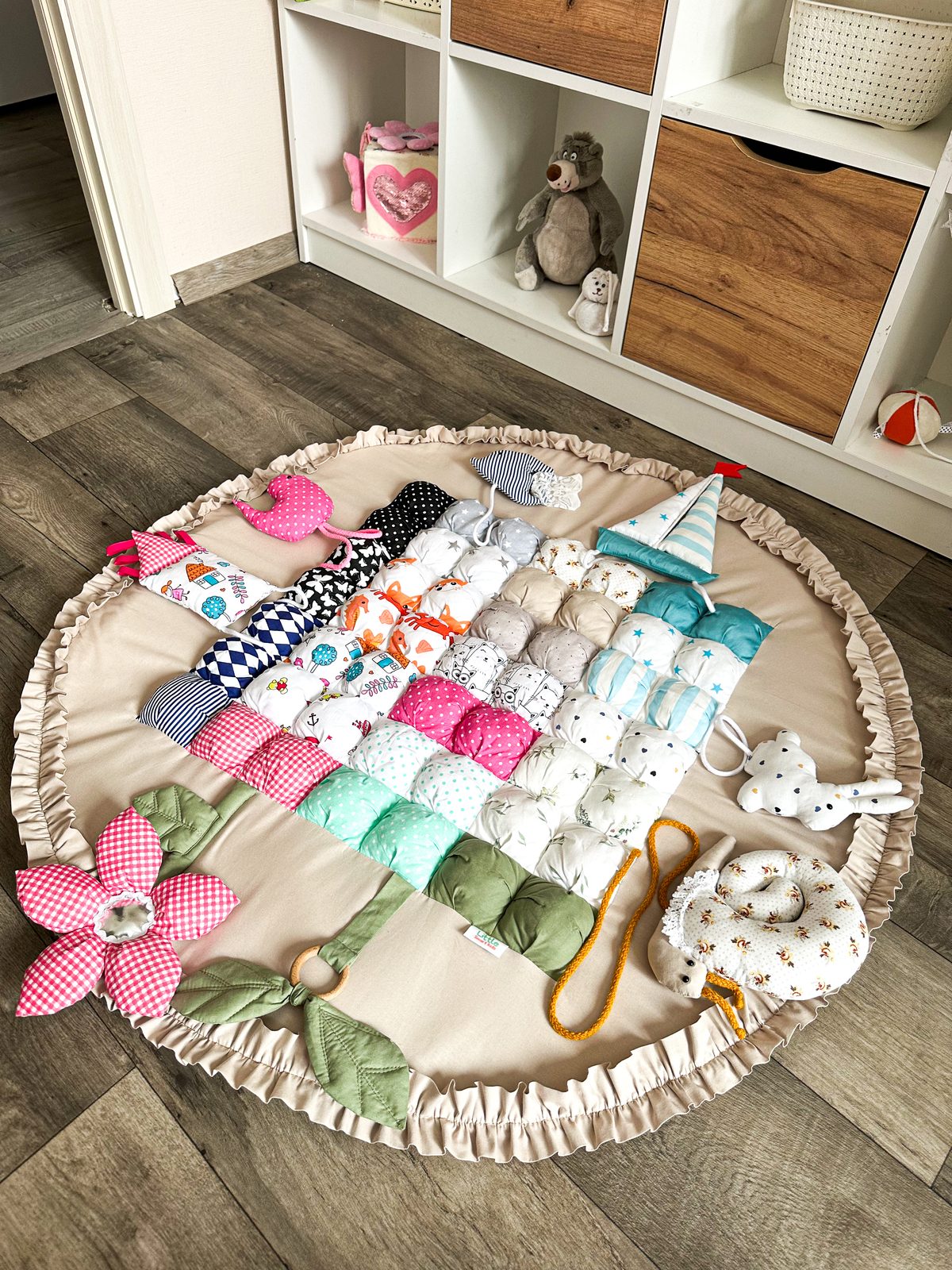
You're standing in front of a wall of baby play mats — or scrolling through endless options online — and the question hits: what size do I actually need?
It's the question I asked when I was pregnant with my first. And again with my second, because somehow I'd forgotten. After buying three wrong sizes between two babies, I learned the answer the expensive way. Here's the honest guide I wish I'd had.
The Short Answer (Quick Sizing Chart)
If you only read one section, read this one. The right size depends on your baby's stage:
| Baby's Stage | Recommended Mat Size | In CM |
|---|---|---|
| Newborn (0-3 months) — Tummy time only | 30 × 30 in | 75 × 75 cm |
| 3-6 months — Rolling, reaching | 39 × 47 in | 100 × 120 cm |
| 6-12 months — Crawling | 47 × 47 in or larger | 120 × 120 cm+ |
| 12+ months — Walking toddler | 59 × 59 in or larger | 150 × 150 cm+ |
These are minimums. Bigger is fine if your space allows it.
Why Size Matters More Than You Think
A play mat that's too small means your baby quickly outgrows it — and you end up buying another one in 6 months. A play mat that's too big crowds your living room, gathers dust, and becomes one of those things you "put away to use later" but never do.
The right size:
- Fits your baby and a few favorite toys at their current stage
- Leaves enough margin for them to grow into for at least 6-12 months
- Folds or rolls into a manageable size for storage and travel
- Fits in your most-used room without dominating it
By Baby's Stage — Detailed Guide
Newborn (0-3 Months): Tummy Time Mats
At this stage, your baby isn't going anywhere. Tummy time sessions are short (2-10 minutes) and stationary. A small, cushioned mat around 30 × 30 inches (75 × 75 cm) is plenty. Look for:
- Soft padding — at least 0.6 inches (1.5 cm) thick
- High-contrast patterns or sensory elements at face level for the baby
- Easy to clean fabric (you will need to)
- Lightweight enough to move between rooms
A small mat at this stage is actually a feature, not a limitation — it's portable, easy to store, and won't dominate your space during these early newborn weeks.
3-6 Months: Rolling and Reaching
Babies start rolling. They reach for toys with intention. They need room. 39 × 47 inches (100 × 120 cm) is a good standard — enough for baby to roll without rolling off, and to spread out with a few sensory toys nearby.
This is also when sensory features become very engaging — crinkle pages, soft textures, crinkle leaves, mirror panels. A mat with built-in sensory elements at this stage gets more use than a plain mat with separate toys.
6-12 Months: Crawling Stage
This is when size really matters. A crawling baby covers ground fast. They need room to move in different directions safely without bumping into hard floor or furniture corners.
Minimum: 47 × 47 inches (120 × 120 cm). Better: 59 × 59 inches (150 × 150 cm) or larger. Round mats around 47-59 inches (120-150 cm) in diameter work well — no corners means no bumped heads.
12+ Months: Walking Toddlers
Walking toddlers don't need a "mat" in the traditional sense — they need a designated soft play space. 59 × 59 inches (150 × 150 cm) or larger works well, especially for sensory path mats with textured walking surfaces, foldable shapes, and zones for different activities.
At this stage, function matters more than dimensions: a foldable mat that becomes a path, a tunnel, or a stepping course extends use through the toddler years.
By Your Space — Choosing for Your Room
Small Apartments
Measure your living room floor before buying. Take painter's tape and mark out the mat dimensions on the floor — does it leave reasonable walking space around it? If the mat covers more than 30-40% of your floor, it's too big. Consider a foldable mat you can put away when guests come over.
Living Rooms (Standard)
Most US living rooms easily fit a 47 × 47 inch (120 × 120 cm) to 59 × 59 inch (150 × 150 cm) mat without crowding. This is where babies spend most of their day — make sure the mat is somewhere you can keep an eye on them from the kitchen or workspace.
Dedicated Nurseries or Playrooms
If you have a dedicated room for baby, you can go bigger — up to 70 × 70 inches (180 × 180 cm). Round neutral-aesthetic mats work especially well in nurseries; they double as the visual centerpiece of the room and look beautiful in newborn photos.
For Travel and Grandparents'
Look for a foldable or roll-up mat in the 30-47 inch (75-120 cm) range. The full-size living-room mat stays home — a compact travel version goes in the diaper bag for road trips, grandparents' visits, and restaurants. Some of our handmade mats fold into surprisingly small sizes for exactly this.
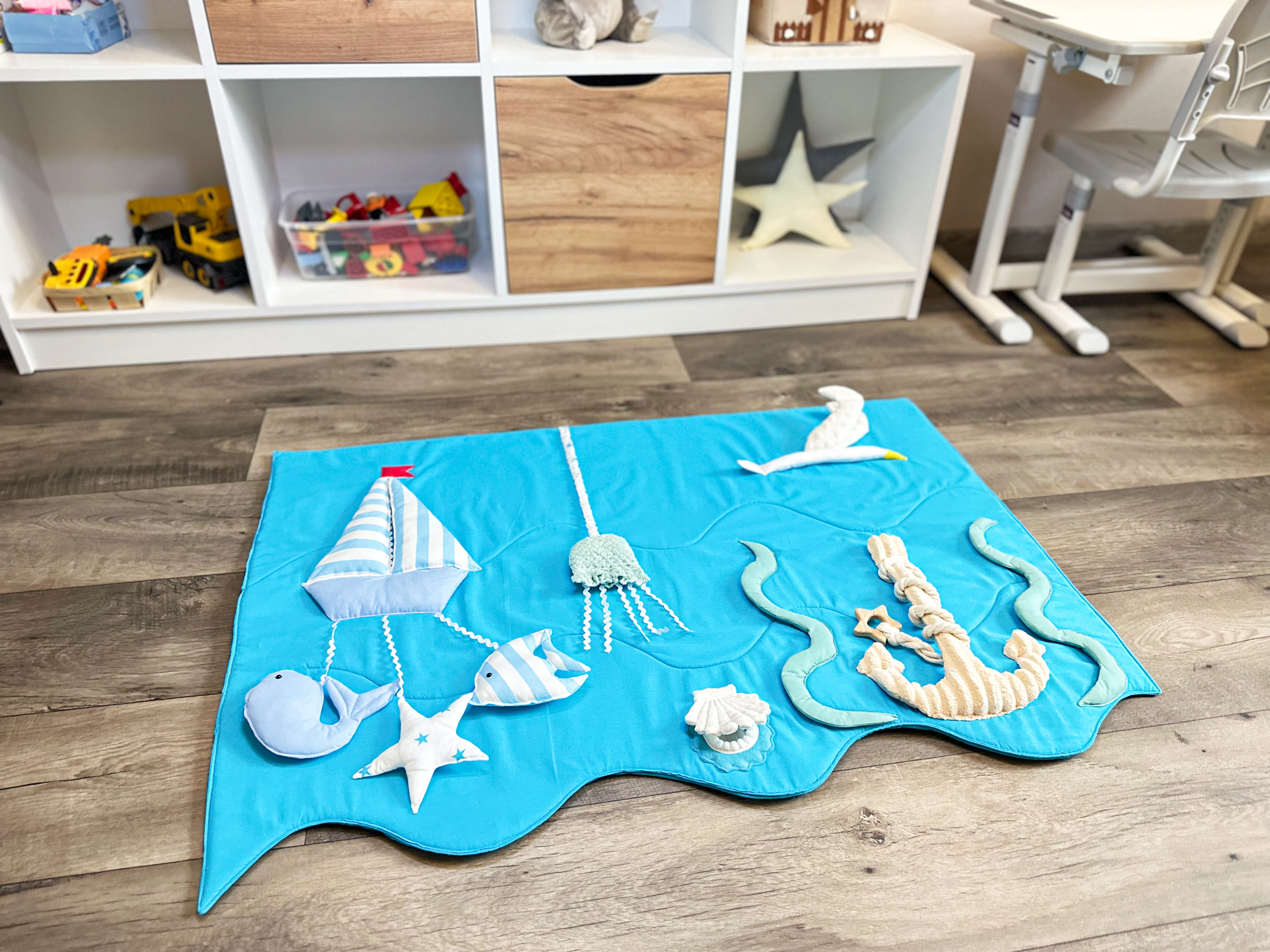
Shape: Square, Round, or Rectangular?
Most parents don't think about shape, but it changes how the mat feels in a room:
- Square mats are the most versatile — they fit corners, line up with furniture, and feel "structured." Best for living rooms.
- Round mats have no sharp corners, look stunning in nurseries, and photograph beautifully. Best for nurseries and photo-friendly spaces.
- Rectangular mats work well for tummy time (baby has room to extend) and along longer walls. Best for narrower rooms.
- Themed shapes (leaf, turtle, flower) become a visual centerpiece — kids form attachments to them. Best for nurseries with personality.
Padding Thickness — Don't Skip This
Size means nothing if the mat is too thin. Babies bump their heads. Knees press into hard floors during crawling. Padding does the real work.
Minimums by stage:
- Newborn tummy time: at least 0.6 inches (1.5 cm) of soft filling
- Sitting/rolling: 0.8-1 inch (2-2.5 cm)
- Crawling: 1 inch (2.5 cm) or more — they fall on it a lot
For hard floors (tile, hardwood, concrete), prioritize thicker padding over more length. A smaller well-padded mat is safer than a bigger thin one.
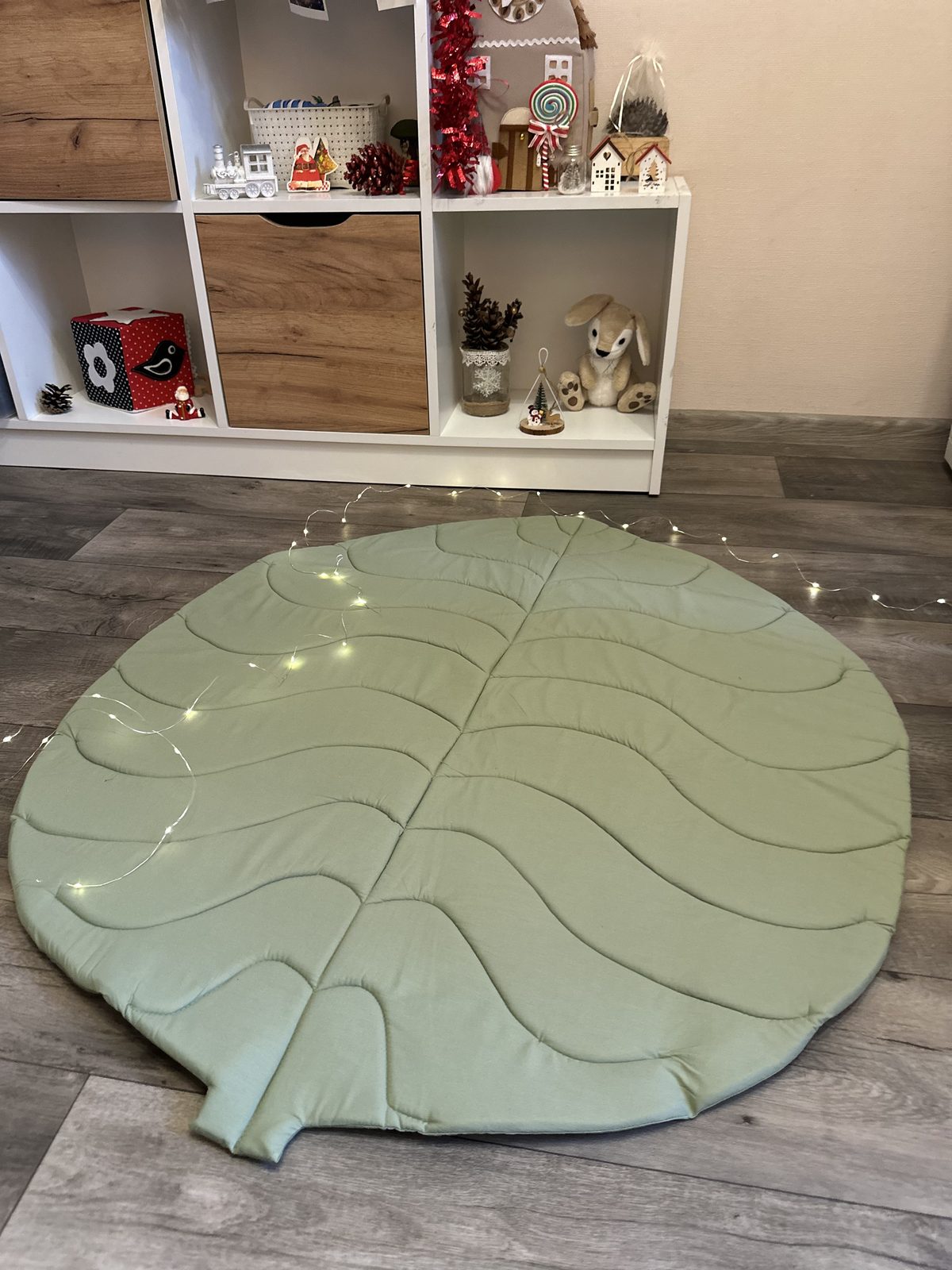
Material — Cotton vs. Synthetic
Whatever size you choose, the material matters. Natural cotton fabrics breathe, feel softer against baby's skin, and don't off-gas in heat. Synthetic foam mats are cheaper but often feel plastic-y and have an initial chemical smell that takes weeks to fade.
Our handmade Little Smart Kids mats are made from soft natural cotton in our small family workshop — fabric pieces are individually cut, sewn, and filled with care. The result is a mat that feels like a beautiful throw blanket, not a foam pad.
Real Talk: Don't Overbuy
The biggest mistake new parents make is going too big "just in case." A 70 × 70 inch mat doesn't get used more than a 47 × 47 inch one — it just dominates more space. Match the mat to where your baby actually is in their development now, with a little room to grow. You can always add a second mat (or a foldable expansion) later.
Frequently Asked Questions
How do I choose the right size play mat for my baby?
Match the size to your baby's stage: 30 × 30 inches for newborns, 39 × 47 inches for 3-6 months, 47 × 47 inches or larger for crawling babies, and 59 × 59 inches or larger for toddlers. Then check that it fits in your most-used room with walking space around it.
What size baby play mat should I buy?
For most parents, 47 × 47 inches (120 × 120 cm) is the all-around best size — large enough for tummy time through early crawling, small enough for most living rooms, and easy to fold or roll for storage.
How big should a tummy time mat be?
At minimum 30 × 30 inches (75 × 75 cm) for a newborn — enough for baby plus a few small toys. As baby grows and starts rolling around 3-4 months, upgrade to 39 × 47 inches (100 × 120 cm) or larger.
Are bigger play mats always better?
No. A mat that's too big for your room ends up stored away. The ideal size fits the room you use it in, has walking space around it, and folds or rolls for storage when needed.
What's the best size play mat for a crawling baby?
At least 47 × 47 inches (120 × 120 cm), ideally 59 × 59 inches (150 × 150 cm) or larger. Crawling babies move in all directions — they need room to explore safely without rolling off the soft surface.
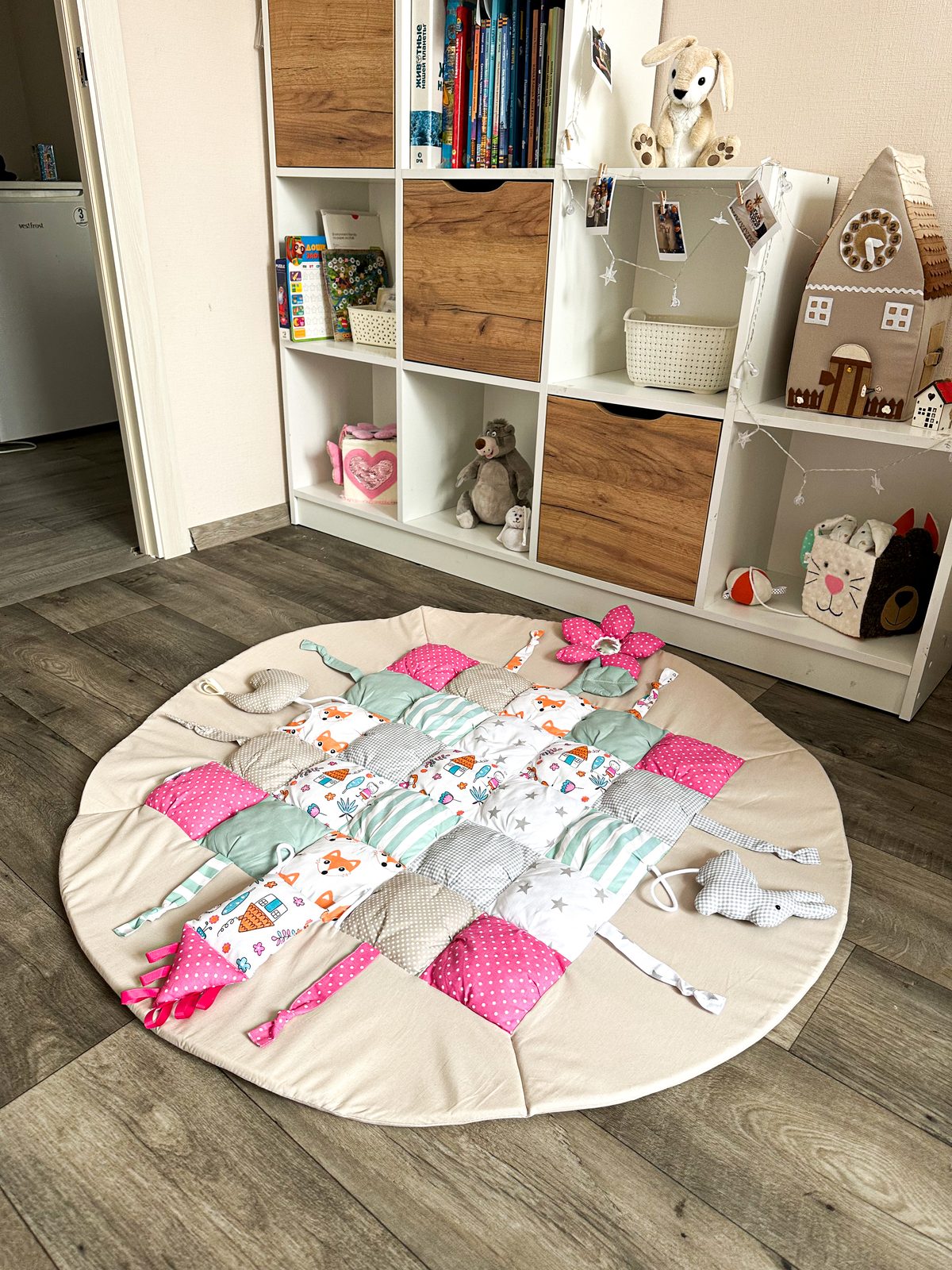
Our Recommendation
If we had to pick one size for most families, it's around 47 × 47 inches (120 × 120 cm). It works from early tummy time through the crawling stage, fits any standard living room, folds for travel, and lasts well into the toddler years.
Our handmade sensory play mats are crafted in this versatile range — designed by a mom of two who measured a lot of living rooms before settling on these sizes.
Looking for a play mat sized just right for your baby? Browse our handmade collection at Little Smart Kids. Each mat is handmade by Karyna and her mom in our small family workshop.